
Why Glasses-Free 3D Belongs in Every AV Integrator’s Immersive Toolbox and How to Win Big
AV integrators in 2026 are no longer just installing displays and audio systems — they are tasked with creating experiences that seamlessly blend into architectural environments and require deep human factors design-thinking. Today’s RFPs increasingly embed “immersive” into the requirements as if it were a checkbox even though the word itself is ambiguous. The trade press has been tracking this for a year or more. Treu Partners called it out in their 2025 outlook, framing immersive technology as “one of the defining shifts shaping integrator work.”
They are not wrong. But the trend coverage, almost without exception, treats immersive and AR/VR as synonyms which they are not. AR and VR are impressive options, but they are not even the same format let alone universal tools for an immersive job. In many real-world environments — lobbies, retail stores, museums, briefing centers, classrooms, and healthcare settings — specifying headsets is like bringing a screwdriver to a job that needs a hammer or like designing a one-person viewing booth when the client needs a room-scale experience.
For most of the projects AV integrators are asked to serve — the constraints of AR and VR are difficult to scale because they deliver only a one-to-one experience, while introducing hygiene concerns, increased operational costs, and complexity that survives long after the initial installation is complete.
The trend is real, but the menu of “immersive” solutions has been incomplete. Glasses-free 3D delivers “wow” factor, it’s impactful, memorable and well-received by the public. The technology belongs on the menu, and integrators who can specify the right 3D solution have a considerable strategic advantage. This article will explain where the technology fits in the client mix, and transparently where it does not, to provide integrators with the confidence they need to harness this impressive technology and get the deal.
What “Glasses-Free 3D” Really Means
The category name tends to cause confusion, so let’s define it. A glasses-free 3D display — is AV slang for the more technical term autostereoscopic — a display that provides stereo vision automatically without glasses or a headset by sending slightly different images or video to each eye. The unique optical approach takes advantage of the fact that most humans have a similar interpupillary distance or IPD, and biology, as the incredible evolution of the visual cortex allows humans to fuse two slightly different perspectives of the world into a 3D image in real-time. This incredible capability provides us with depth perception and a shared reality we can trust spatially. More easily put, the display is in a sense wearing the 3D glasses instead of the viewer.
These unique display systems are known for being able to support many viewers at the same time which has also led to the term “multi-view” display.
Unfortunately, Glasses-free 3D is often conflated with other technologies such as Anamorphic or Forced Perspective LED which only works from one viewing position and does not use any stereo content or special optics. While Anamorphic looks great on social media, in person the content is stretched and warped severely making it tough on the eyes for anyone at even a slight angle. The content doesn’t “pop” forward off the display like it does with glasses-free 3D. More recently, the term Glasses-Free 3D has also been borrowed for describing transparent light boxes that have fixed white background and generally feature a 2D video of a person or character inside the box albeit in 2D. Neither of these solutions nor those noisy spinning fans are true glasses-free 3D displays or even 3D at all.
Why Glasses-Free 3D is no Longer a Novelty
It’s easier to ignore new technology then to embrace it – but calling Glasses-Free 3D a “novelty” is not defensible today and below are three market signals that make the point:
Commercial deployments are operating at scale. Glasses-free 3D displays are in the field today in major theme parks, luxury hotels, cruise ships, specialty grocery stores, flagship retail, healthcare, education, aerospace, and show up frequently in brand activations due to their innate stopping power. These projects are no longer pilots; they are budgeted commitments specifying Glasses-Free 3D which continues to show up in more RFPs as the tech has matured.
Sometimes the term holographic or volumetric displays are inserted into these design-builds which then leads AV companies to seek a “holographic display” solution. Glasses-Free 3D systems are efficient and cost-effective solutions to mimic holographic effects or “pepper’s ghost” without lasers, projectors, mirrors, scrims, mist or fog. This is also why the tech is finding its place in the AV toolbox as a commercial-grade and budget-friendly solution to meet these new immersive visual effects (VFX) demands.
The content economics have done a 180. A few years ago, getting content into glasses-free 3D production required expertise few had in house and those that did needed a render farm running 3D Studio Max or Maya. This limited the category to major attractions and premium brand experiences or PR stunting events that could afford the time, talent or budget.
Today, thanks to the explosion of AR and VR as well as the expansive pipelines for movies, games and animation studios, 3D production is everywhere. Making glasses-free 3D content is as easy as swapping a camera plugin. Not only are the tools intuitive, but they support platforms with millions of creators such as Blender, Cinema 4D or interactive game engines such as Unity and Unreal.
Quality has gone up, costs have come down, and timelines that once stretched across weeks can now be measured in days with some projects rendering in a few hours. Content used to be the bottleneck. Now it’s the reason the category is ready to explode because generating 3D images and video with AI is easy and access are only accelerating. Suffice it to say that glasses-free 3D content production is being democratized at a planetary scale and you don’t want to be late to the party.
Consumers are buying Glasses-Free 3D Displays. 3D gaming monitors are back, this time without the glasses. What started a few years ago in China and Korea is picking up speed and finally making its way west as consumer electronics giants start adding more glasses-free 3D desktop options to their product lines. Glasses-free 3D moving into the home means the tech is no longer a consumer electronics show proof-of-concept but a technology that consumers will have on their desk and expect to see in public spaces. An integrator who has never specified glasses-free 3D or at least considered the tech as a strategic option is likely to be playing catch-up before long. Become a Magnetic 3D sales partner by clicking here.
None of this is to say the technology is a universal silver bullet for immersive projects, it’s up to integrators to add glasses-free 3D to their toolbox and know when and where it fits to deliver the user experience clients are seeking. The following section helps provide some ideal applications and use cases to bridge this knowledge gap.
Where Glasses-Free 3D Displays Fit — Five High-Value Integrator Verticals
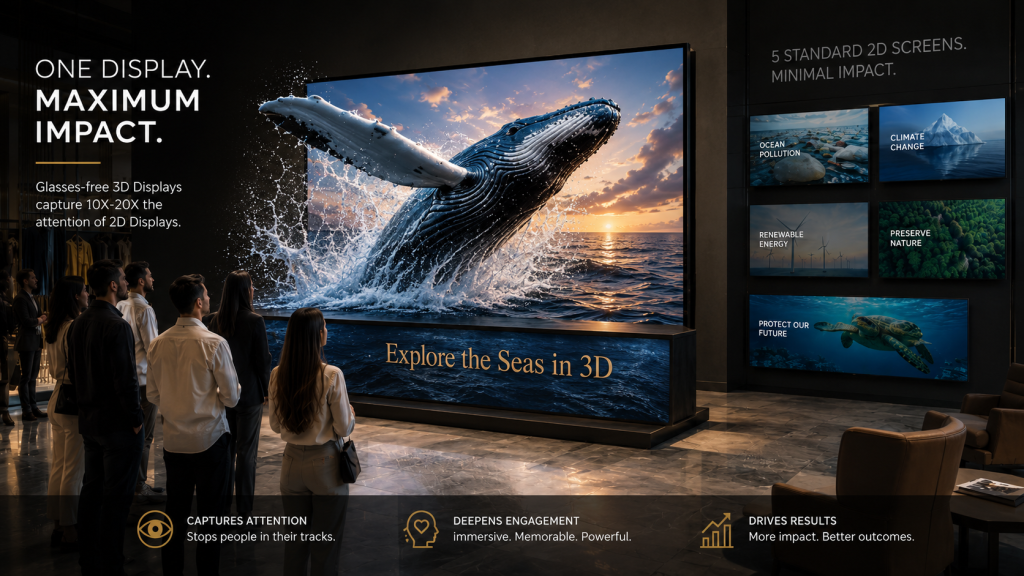
The right way to think about glasses-free 3D is not as a replacement for every display in a venue, instead, consider strategic placement for maximum impact. Glasses-Free 3D displays can deliver greater impact than five or more 2D monitors of similar size. A higher cost is justified by their unique ability to provide exponential engagement.
When a client brief is seeking an AV experience with incredible storytelling capacity that captures the viewer’s attention and immerses them in the brand, products, solutions, data sets, and history – or – they want a “wow” factor that conjures meaningful and sustainable engagement – then glasses-free 3D is the ideal candidate. The applications and use cases become quite clear, especially if the immersive experience must support multiple viewers without subjecting them to VR headsets. Imagine these possibilities.
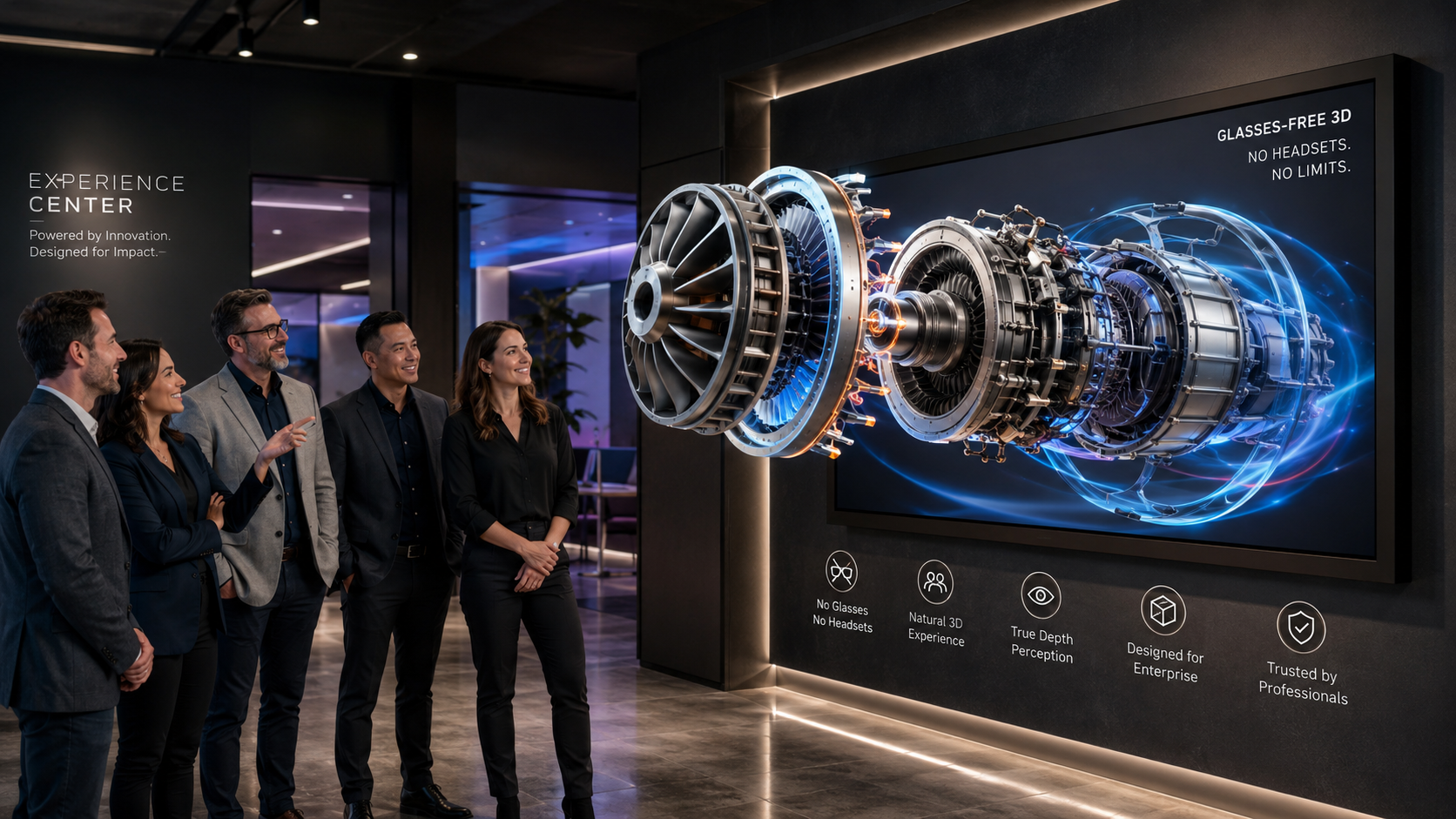
Enterprise and Executive Briefing Centers. Executive briefing centers, innovation labs, corporate lobbies, sales experience centers, and product visualization environments where enterprise AV budgets are often used to create moments of understanding and persuasion. A briefing center that can present a product, facility, data structure, digital twin, or system architecture in genuine dimension does something a flat video wall cannot: it makes complex ideas easier to see, explain, remember, and discuss. For sales-driven companies, glasses-free 3D can become a closing tool. For engineering-driven companies, it becomes a comprehension tool that gains executive buy-in. 3D technology covers both jobs well.
Retail, Luxury, and Brand Experience. Premium retail clients are increasingly asking for in-store experiences that compete with the visual sophistication customers see online, at events, and in entertainment environments. A handbag, watch movement, high-end jewelry, sneakers, fragrances, all benefit from dimensional presentation in ways flat signage can simply not match. For flagship stores, pop-ups, showrooms, and partially shaded or interior storefront windows, glasses-free 3D gives integrators and creative agencies a way to turn product storytelling into a physical visual encounter. For many large ticket items including power tools, home improvement, bathroom and kitchen redesign, home energy systems, and automotive – glasses-free 3D offers a way to visualize a brand’s core value proposition, unique style, or technology innovation while maintaining customers attention long enough to ensure they understand the message.
Healthcare and Life Sciences. Patient education, surgical planning, medical training, anatomy visualization, medical device demonstrations, and life-sciences are all environments where spatial understanding really matters. A dimensional display allows clinicians, patients, students, and stakeholders to see anatomy, procedures, devices, and biological structures as 3D objects rather than flat illustrations that are confusing to those without an advanced degree. Single-viewer eye-tracked systems may serve precision for clinician workstations, while wider-angle multi-view displays can support patient education, surgical planning, DICOM visualization, waiting areas, medical conference rooms, training labs, and healthcare experience centers. Integrators working healthcare accounts should understand both flavors of glasses-free 3D technology, single and multi-viewer systems and where each applies.
Higher Education, Simulation, and Training. Lecture halls, medical and dental schools, engineering labs, architecture studios, simulation centers, and workforce training environments all benefit from 3D visualization. The advantage of glasses-free 3D is that it does not require students, trainees, or instructors to put on equipment. An instructor can instead demonstrate to the entire room in 3D. This puts the visual control back in the hands of educators who can direct the classrooms attention to a specific place or object in 3D space with ease instead of dozens of students fumbling with headsets and looking where they choose. For integrators serving education, healthcare training, aerospace, defense, engineering, or technical workforce development, glasses-free 3D fits naturally into the way group learning happens – collectively and collaboratively.
Museums, Attractions, and Experiential Environments. Museums, science centers, theme parks, aquariums, zoos, visitor centers, brand activations, trade shows, and traveling exhibitions are among the most natural environments for glasses-free 3D. These are places where audiences expect visual impact, shared discovery, and memorable moments — but where headsets often create friction, administrative burdens, hygiene concerns, and throughput limitations. Glasses-free 3D allows artifacts, characters, animals, fish, environments, products, and scientific concepts to appear in 3D dimensional automatically without any additional staffing or management of equipment. Integrators serving these accounts will be heroes by making it easier to deploy 3D that glasses or headsets and much less costly to maintain. It’s the chance to deliver immersion without the operational headaches.
Where Glasses-Free 3D Displays Aren’t the Best Choice — and When Integrators Should Say So
This is the part of the conversation most vendor pitches skip but is an important point to delineate between where 3D works and where it doesn’t.
Glasses-free 3D is not a great fit for outdoor yet – can it be done? Yes. But in direct outdoor sunlight ensuring readability is generally tough to overcome as the 3D effect needs sufficient brightness and contrast. The optics aren’t ideal or proven in large unshaded digital out-of-home installations either. Think roadside ads, stadium size boards, or time square spectaculars. These projects call for LED and rightfully so as the tech has been engineered for this purpose. Glasses-Free 3D lenses are optically bonded to LCDs which limit their heat tolerance and most top out at approximately 115”. While multiple systems can be tiled together the costs are prohibitive for outdoor, mullions or bezels are introduced between displays that interrupt the 3D image continuity, and optical physics of 3D LED remains a problem to be solved.
Multiview 3D is also not the best option if the viewing distance is close, (i.e., under five feet) or if traffic runs parallel to the monitor. Examples of this proximity issue abound as 2D print or 2D LCD don’t suffer the same challenge – think of traveling down a moving walkway or the jetway where viewers can sometimes be inches away from the media or leaning right on it. Glasses-Free 3D is best when viewed perpendicular to traffic flow with viewers headed toward the display or in wide open area where the viewers can explore the depth perception afforded by the medium.
Touchscreens and 3D are a nice idea, but unless the monitor uses eye-tracking 3D technology (commonly referred to as a single-viewer 3D display) and is less then 32”, the viewer will be too close to see the 3D content and will instead experience crosstalk, a visual issue where the images delivered to each eye overlap causing disturbing artifacts. The programming for this type of installation also requires additional thought as the user will not be able to touch items that are floating off the display and will have issues with depth perception when seeking to press 2D menu options.
An integrator who knows where the technology works and when it will fall flat has the edge and can build client trust. Learn more about becoming a Magnetic 3D partner here.
How to Evaluate Environments – a Few Valuable Tips
Three hints that separate a great glasses-free 3D deployment from one that has room for improvement.
First, content is still king. The display, 2D or 3D, is just the delivery mechanism. A glasses-free 3D screen running 2D or 3D media assets that were never authored for the format is the most common failure in the category. Scope the 3D content as its own line item in the proposal, be thoughtful about its creation and purpose, commit a reasonable production budget – and perhaps most importantly, work with a creative partner who has produced for the medium before or at least as some prerequisite experience with stereo 3D, 3D animation, AR or VR.
Second, match the correct 3D format to the audience. Some 3D systems use eye-tracking and are built for a single viewer while others are meant for crowds. A clinician’s workstation has different requirements than a flagship retail window. Ask the vendor — including us — to be specific about viewing angles, viewing distances, and crowd performance for the actual use case to ensure you have the right system for the job.
Third, direct sunlight and glare can be tricky. Glasses-free 3D lenses can reflect light differently than a traditional LCD with a haze. Adjusting the angle of the monitor can be a quick fix. Interior installations and outward-facing window installations with partial shading are fine, pumping up the brightness is also an option. However, you’ll want to think about anti-reflection or anti-glare glass to help improve the contrast of the display and transmissivity as you would a standard LCD. Seek environments where lighting is controlled and you’ll have an easier time deploying out-of-the box solutions during the install.
Each of these are tips are general guidance, not hard fast rules as each installation and experience has its own set of requirements and workarounds that can exceed expectations.
The Final Point – You Can Do This
Every AV Integrator is tasked with convincing a client of their capabilities based on past projects and once they’ve won the deal, the real work begins to prove their mastery of many technologies, all of which need to behave and cooperate cohesively under the most demanding circumstances. No pressure!
Many times, these wins are wildly unique use cases that have never been tried before, and yet, the AV integrators must trust in their team’s abilities and their manufacturing partners to cross the Rubicon together and deliver on time and on budget.
Scope creep aside, this is the creative gap that exists between the knowable and unknowable when a new project kicks off, between what was decided in discovery and previz versus how the real-world works. It’s the chasm between a down and dirty mockup for budget approval and the effort to turn that vision into reality at scale.
The word “immersive” widens the gap further and it’s natural to feel uncomfortable operating here where decisions carry more risk – but this gap is where real innovation happens and reputations are made or broken.
Becoming fluent in immersive technologies like Glasses-Free 3D and understanding how and where they work best is key to elevating your craft and delivering projects that clients never dreamed possible. This know-how in your immersive toolbox – the key differentiator for when the next brief rolls in.
About the Author
Tom Zerega is the Founder and CEO of Magnetic 3D, an innovative, glasses-free 3D technology Company based in New York City. Though an entrepreneur, angel investor, media personality, and inventor, Tom is currently most recognized in the public spotlight today as expert on glasses-free 3D technology and AI.
About Magnetic 3D
Magnetic 3D is the industry leader in glasses-free 3D technology, delivering the only unified platform for holographic and immersive B2B applications without the need for 3D glasses or VR headsets. The company’s proprietary, state-of-the-art display hardware, professional software solutions, and AI-driven workflows are designed to unleash an abundance of the world’s 3D content. With over 20 years of innovation in autostereoscopic technology, Magnetic 3D has built the most comprehensive product line of headset-free 3D visualization systems—spanning desktop displays with eye-tracking for single-viewer applications to large-format, multi-viewer solutions for digital signage and Pro AV, including 100” 3D monitors in both landscape and portrait formats, as well as massive 3D video walls for immersive installations.
Headquartered in New York City, Magnetic 3D serves a broad range of industries where visual impact and spatial awareness are game-changers, including advertising, retail, hospitality, education, healthcare, simulation and training, themed entertainment, corporate environments, aerospace, and defense. The company empowers both end-user customers and the developer ecosystem with next-generation spatial and immersive computing capabilities, enabling the deployment and visualization of holographic 3D content anywhere—without VR headsets or 3D glasses. The technology delivers dramatically higher engagement—up to 2,000% increase over traditional 2D media—featuring captivating off-screen “pop” and incredible depth perception—making it a powerful tool for both storytelling and performance-driven applications.
For more information on Magnetic 3D’s products and services go to https://magnetic3d.com/ or email info@magnetic3d.com